Essay on the history of Schaumburg-Lippe from 1750-1850, the administration, and rural society
Explanations of the following terms:
-
Einlieger—tenants, without a house of their own, in rural areas mostly farmhands, workers, and craftsmen with their families. They lived in seperate rooms on someone else’s farm, or—where there were estates (owned by monasteries/church or nobility)—in cottages built for workers. The most important difference between a farmer or property owner and an ‚Einlieger‘ was that the latter were not allowed to use the common assets (forrests/wood, pastures) while they also had to bear community burdens. Only if they had been born in the village, they were entitled to receive poor relief.
-
Anerbe—principal heir, one heir gets the whole property so that it remains intact, while the rest of the possessions is given to all the entitled heirs. The principal heir often had to pay a compensation to the other heirs.
-
Hausherr—head of the household (not necessarily owner of a house), householder
-
Knecht—farmhand, servant. Before the industrial revolution (which in Germany happened much later than in England, mostly in the 2nd half of the 19th century) almost every son of a farmer became a ‚Knecht‘ before either inheriting the farm, or marrying into another farm. Many remained farmhands all of their lives, and not all of them were allowed or enabled by their employers, local authorities and the local living conditions to marry and have a household of their own. (The same applies for the female servants, the ‚Mägde‘.) This was a common incentive for emigration.
-
Reuter—military expression based of an old word for ‚Reiter‘ (rider, equestrian) in the 17th-19th century, cavalryman.
-
Caribinier—Karabinier, old expression for soldier armed with a carbine
The Familienschein for Carl Friederich Krueckeberg was compiled by the local vicar especially for the purpose of emigration. He extracted all the information on the family from the church records of Petzen on 23 Sep 1850. If there is an original of this document, we need to look in the parish archive of Petzen.
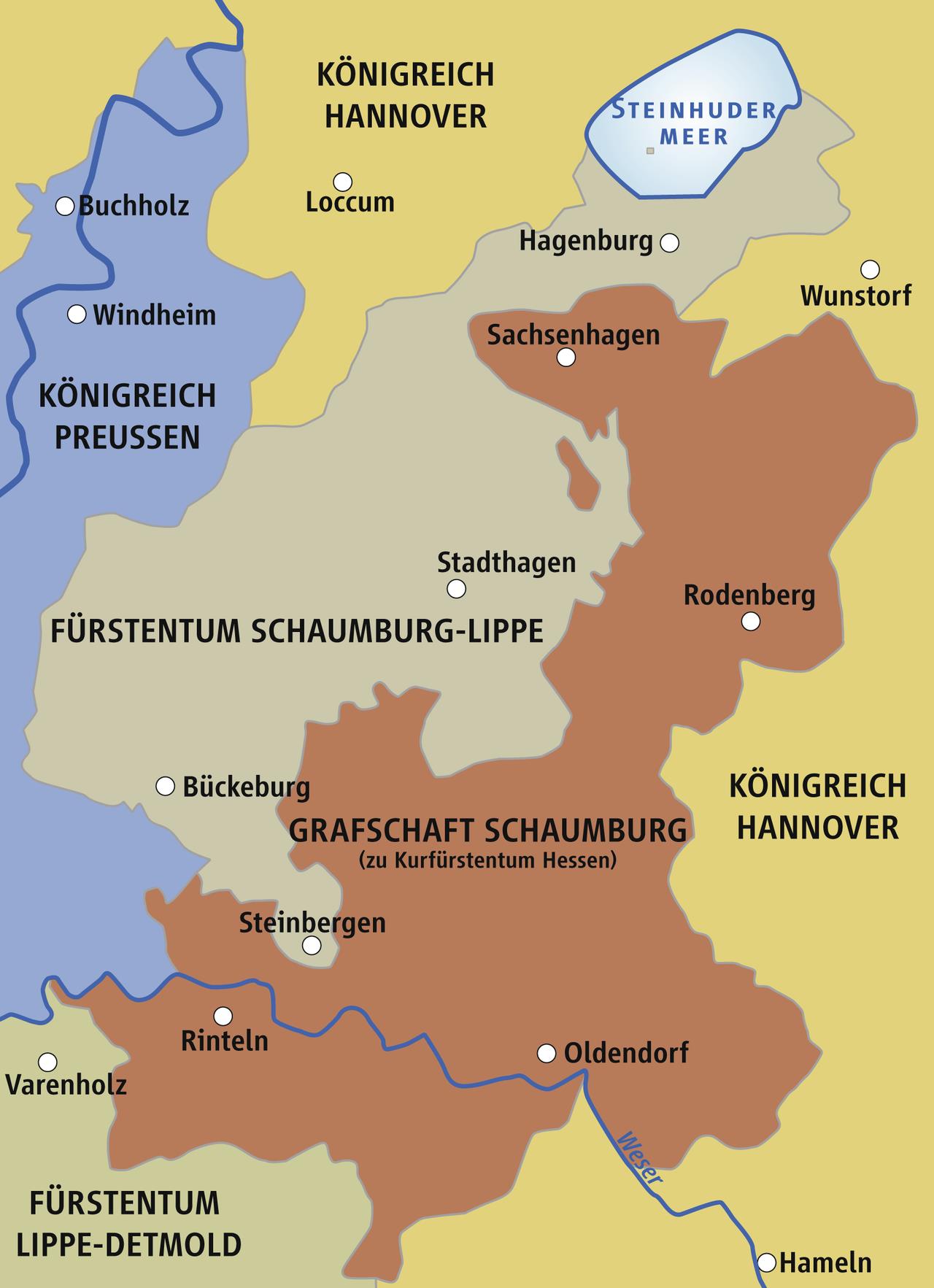
Principality Schaumburg-Lippe (Source: Von Ziegelbrenner - own drawing/Source of Information: Putzger – Historischer Weltatlas, 89. Auflage, 1965; Westermanns Großer Atlas zuur Weltgeschichte, 1969; Haacks geographischer Atlas. VEB Hermann Haack Geographisch-Kartographische Anstalt, Gotha/Leipzig, 1. Auflage, 1979; dtv-Atlas zur Weltgeschichte Band 1: Von den Anfängen bis zur Französischen Revolution; 23. Aufl. 1989, ISBN 3-423-03002-X;, CC BY 2.5, https://commons.wikimedia.org/w/index.php?curid=23878104)
Schaumburg-Lippe
The County of Schaumburg-Lippe, established in 1647 and elevated to a principality in 1807, was one of the many independent states of the Holy Roman Empire and among its smallest. Following the partition of the County of Schaumburg in 1647, its territory comprised several administrative districts (Ämter), including the Schaumburg districts of Blomberg, Bückeburg, Stadthagen, Arensburg, Hagenburg, Schieder, Steinhude, and parts of Sachsenhagen, together with the Lippe districts of Lipperode and Alverdissen. In 1748, the district of Blomberg was ceded to the County of Lippe-Detmold, followed in 1777 by the district of Schieder (Köbler, p. 620). In 1788, the county had approximately 25,000 inhabitants, more than 6,000 of whom lived in small towns (Sauer, p. 50). The capital was Bückeburg, with its residential castle, and the territory also included a military academy, Wilhelmstein, located on an island in the Steinhuder Meer, a lake at the northern border of the state (for general information on the state of Schaumburg-Lippe, see Hauptmeyer).
Schaumburg-Lippe was predominantly a rural society, with small towns serving as local markets where villagers could sell their agricultural produce. To the west, the border with Westphalia (Prussia), the large episcopal town of Minden, and the River Weser—an important trade route—offered opportunities for crafts and commerce. To the east lay Hanover, the capital of the Duchy, and later Kingdom (from 1815) of Hanover, while the County of Schaumburg, part of Hesse, bordered the territory to the southeast. As the residence of the Counts and Princes of Schaumburg-Lippe, Bückeburg attracted a certain amount of trade and business (on Schaumburg-Lippe’s trade, see Kaufhold, pp. 17–20). From the Middle Ages onward, mining activity is documented in the region, concentrating primarily on hard coal. Some of the oldest mines were located on the Bückeberg, a hill southeast of Stadthagen, and in the Obernkirchen area east of Bückeburg. Glassmaking was another early industrial activity. In the late eighteenth and nineteenth centuries, linen weaving developed into an important form of domestic, home-based industry (Schneider, pp. 131–139).
After the Congress of Vienna in 1815, which laid the foundation for the post-Napoleonic order in Europe, the old political order was restored in the North German territories, although these states were now obliged to introduce a basic form of parliamentary representation. This representation, however, remained entirely rooted in the traditional feudal hierarchy. Membership in the Ständeversammlung was restricted to very wealthy individuals, predominantly from the nobility; even farmers with substantial landholdings were scarcely represented, and women of all social classes were excluded altogether.
A constitution was enacted in Schaumburg-Lippe in 1816 (valid up to 1868), that decreed:
§ 4. All our dear and loyal subjects of our Schaumburg lands are entitled to representation in the state parliament, such that:
the actual owners of noble estates,
deputies of the towns and villages,
deputies of the subjects of the districts,
shall be authorized to appear at the state parliament.
The new constitution, while granting the nobility as well as rural and urban inhabitants a limited and indirect influence on the country’s political course, did not alter its fundamentally feudal character. The town of Bückeburg, which had been developed as the Schaumburg residence since the early seventeenth century, became the seat of the new state government in 1647. The central institutions of government—the Rentkammer (Revenue Chamber), Justizkanzlei (Justice Office), Lehnskammer (Feudal Chamber), and Konsistorium (Consistory)—were located there. Local administration was organized at the district level (Ämter, see above). In each district, an official (Amtmann) based in a local Amtshaus (office building) exercised judicial authority (Amtsgericht) and supervised the collection of taxes and dues in the villages belonging to the district. These taxes and dues were then forwarded to the Rentkammer in Bückeburg.
Amtshaus Stadthagen
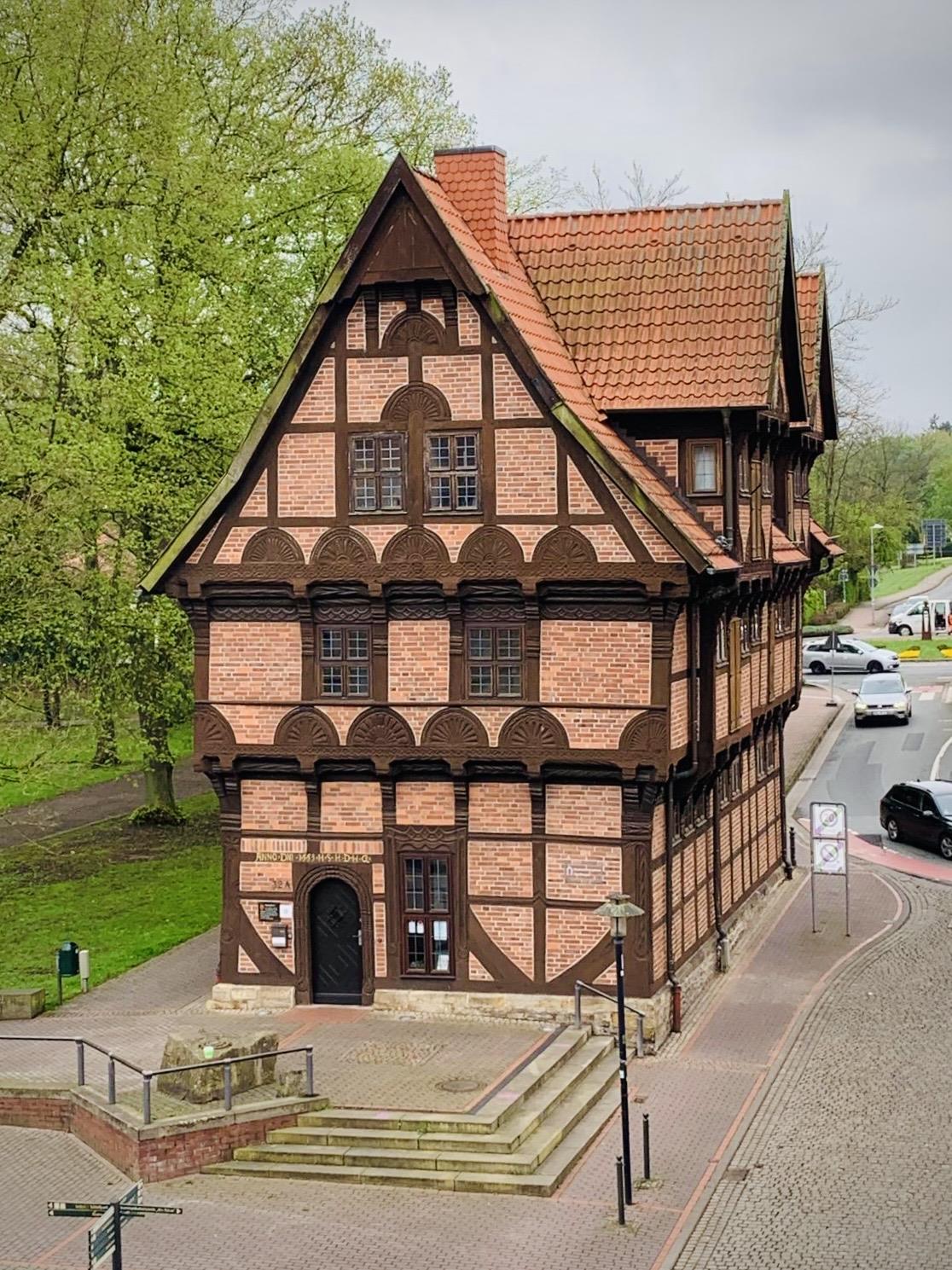
In each district, the Amt and its head official, the Amtmann, constituted the local authority responsible for assessing and mediating conflicts or—-as in the case of Johann Heinrich Krückeberg TODO add year—matters involving debts and loans. The Amtmann was required to report to the central authorities in Bückeburg, and in financial matters specifically to the Rentkammer. Inhabitants of the district were required to appear before the Amtmann to obtain official permission for land and property transactions and for marriages, and to have these acts formally recorded in the district protocols (contract books). In addition, individuals were not permitted to leave the territory without applying for authorization; men, in particular, were required to complete military service before such permission would be granted (for general information on Ämter and Amtmänner, see Klingebiel).
Life in the villages was shaped by long-standing dependencies and obligations. Farmers were required to work on the prince’s or a noble landowner’s estate for several days each year and to pay various taxes, both in kind (for example, eggs or chickens) and in money, the most important of which was the Zehnte (the tithe). These obligations arose from the fact that the farmland did not belong to the farmers themselves but formed part of feudal property. Some of these dues originated in older forms of feudal dependence, elements of which remained in force: subjects still needed their lord’s permission to marry or to leave the territory. Fees were also payable in the event of marriage or death, since such occasions involved the transfer of property rights.
TODO: Resume here! Though a farmer passed on the property to his heirs, theoretically the landlord could have taken it away from the family (which happened when someone was seen as unfit). This ancient system was finally abolished in Schaumburg-Lippe after a law passed on 24 January 1845 (Meyer, p 219-221). Farmers could ‘buy themselves off’ by paying a larger sum of money and did now own their land and stopped having to pay the old taxes. Yet, the law in Schaumburg-Lippe had been made reluctantly and included almost unmanageable conditions for the farmers, so that the whole process did take a long time, while neighboring states were going through this step of modernisation much faster (Behr, p 48, also State Archive file NLA BU K 2 D Nr. 233).
The change also included the ‘Verkoppelung’ – a more rational distribution of the land between all farmers, which also included the dissolution of the common meadows and land. This deprived some of the poorer inhabitants of their share. In addition, means of intensifying the cultivation and increasing the crop were introduced, leading to a decrease of labor needed in agriculture.
In a typical north German village of the late 18th and early 19th century we find farmers (Meier, Halbmeier, Viertelmeier, Ackermann, Bauer), tenant farmers who have a house and some land, but not enough to live on, so often perform a craft (Koeter/Koethner), inhabitants who own a house and garden but no land at all and usually work as farmhands or craftsmen or as seasonal workers (Brinksitzer), inhabitants who do not own land or a house but rent a house or room, work as craftsmen or farmhands (Häuslinge, Einlieger, Heuerlinge, Einwohner = tenants). The craftsmen found in villages were shoemakers, blacksmiths, carpenters, painters, joiners and tailors.
A first change of the strict rural social bonds had been brought about by home industries, like linnen weaving. In a growing population, those who did not inherit had to earn a living as servants/farmhands, often without any chance to marry and have a family. The home industry finally enabled young people to set up a household quite early and own a living, if the whole family worked. The introduction of machines, the import of cheaply manufactured cotton cloth from England, and finally the developing industrialisation in the cities and towns after the railways were built in the middle of the 19th century, put an end to this development (in general on rural society in northern Germany see Abel and Achilles). Tenants in a village who did not own a property could not participate in the privileges attached to it – to use the common land for grazing sheep and cows, to use the wood from the common forests, and the garden land. And, perhaps more important, if they had not been born in the village, they also had no right to be there and could be forced to leave in case of poverty or illness. The rudimental welfare system of the time was communal, based entirely on the birth place – only the village/parish where an individual was born had to support this person. Nowhere else could he or she expect to receive help, or the permit to stay, and, if someone left his place of origin to work in the nearest town, he or she, if unable to sustain him/herself was certainly expelled from there and forced to go home. The aim had to be to obtain citizenship in town, or a permit of residency in a village – as long as workers were needed, even people without any property were admitted. But throughout the late 18 th century conditions changed. Guilds closed to preserve their members’ income and did not admit any new masters, and the risen urban as well as rural population meant that the number of poor also rose. Authorities, both in towns and villages, became very strict when it came to citizenship/residency, a permit to marry or support in cases of poverty (Möhle, Partnerwahl, p 61). Both men and women married late – with the exception of noble couples, and women of bourgeois background who were married young to older men who had already made their carreer in the academic field or administration. But in rural society, as in mining or the crafts both in villages and towns, men and women were mostly in their mid-twenties or older when they got married for the first time (exception the home industry, compare above). Everyone needed communal permission and parental consent to get married. Men and women were under their parents’ guardianship for much longer than today, until they were 24. On farms, a son or daughter had to wait until the parents withdrew to their ‘Altenteil’, the seperate little flat in the farmhouse that they would live in for the rest of their lives after handing over the property to their children. Usually a contract had to be set up to regulate what share of the harvest they would receive each year, and what rights and obligations they had on the farm. There were groups that were not allowed to marry – journeymen before they became masters, soldiers, students. Soldiers could receive a dispens and get married (Möhle, Ehe, p 127-133). The percentage of illegitimate children was above 10 %. Some couples had several children before they finally could get married. Many women stayed unmarried and had to continue
working as servants. Their children were placed in foster families. Pregnancies were frequent, often a child was born every 1 ½ - 2 years. Many children died young. When after the turn of the century vaccinations were introduced, the situation improved, but serious illnesses still caused many early deaths, and many women died in childbirth (Möhle, Nicheheliche p 192-193). Every village had a midwife who had usually been trained by her antecessor. The midwife looked after the mother of a newly born daily for six weeks, until the woman was seen fit again to go out (and attend church, which she was not allowed to do in these weeks). Women gave birth at home. In the second half of the 18th century, maternity clinics were founded in larger towns (for instance in Hannover, Celle, Göttingen). These clinics were used to train doctors and midwives who step by step lost their independent status and, instead of learning from another experienced midwife, had to attend courses in the clinic that were given by male doctors. In tenants’ families children had to leave as soon as possible, often at the age of 12, and work, girls as servants on farms or in households, boys as apprentices or as farmhands. Farmers’ children had to help early in their lives, and school was not always regularly visited, especially during harvesting. Both boys and girls attended up to their confirmation which regularly should have been at the age of 14. Poor families often applied for earlier confirmation of their children at the age of 12 or 13, so they could start working as child servants. Children also worked in the mines. The knowledge they had to acquire at school mainly served their religious education – they should be able to read the Bible and the catechism. In addition, writing and simple arithmetic problems were taught. In the 18th and early 19th century most women and many men signing documents signed with three ‘+’, showing that they had not even learnt to write their names (Brüdermann in general, and p 36). Sources and Studies Wilhelm Abel, Geschichte der deutschen Landwirtschaft vom frühen Mittelalter bis zum 19.Jahrhundert. (Deutsche Agrargeschichte. Bd.2). 2. Ed.Stuttgart 1967. Walter Achilles, Die Lage der hannoverschen Landbevölkerung im späten 18.Jahrhundert. (Veröffentlichungen der Historischen Kommission für Niedersachsen und Bremen. 34. Quellen und Untersuchungen zur Wirtschafts- und Sozialgeschichte Niedersachsens in der Neuzeit. Bd.9). Hildesheim 1982 Hans-Joachim Behr, Revolution auf dem Lande. Bauern und ländliche Unterschichten 1848/49, in: Westfälische Zeitschrift 150 (2000) p 43-127 Stefan Brüdermann, Über Schaumburg-Lippes ländliche Elementarschulen im 18. Jahrhundert, in: Hubert Höing (Ed.), Zur Geschichte der Erziehung und Bildung in Schaumburg, Bückeburg 2007, p 11-43
Franz Engel; Die Schaumburg-Lippischen Archive und zentralen Registraturen. Ihre Geschichte und ihr Inhalt (Veröffentlichungen der niedersächsischen Archivverwaltung 4), Göttingen 1955 Carl-Hans Hauptmeyer, Souveränität, Partizipation und absolutistischer Kleinstaat. Die Grafschaft Schaumburg-(Lippe) als Beispiel. Hildesheim 1980 (Quellen und Darstellungen zur Geschichte Niedersachsens 91) Karl Heinrich Kaufhold, Gewerbelandschaften in Norddeutschland – historisch gesehen, in: Hubert Höing (Ed.), Strukturen und Konjunkturen. Faktoren der schaumburgischen Wirtschaftsgeschichte, Bielefeld 2004, p 13-26 Thomas Klingebiel, Ein Stand für sich? Lokale Amtsträger in der Frühen Neuzeit: Untersuchungen zur Staatsbildung und Gesellschaftsentwicklung im Hochstift Hildesheim und im älteren Fürstentum Wolfenbüttel, Hannover 2002 Gerhard Köbler, Historisches Lexikon der deutschen Länder. Die deutschen Territorien vom Mittelalter bis zur Gegenwart. 7. Ed. München 2007 Stefan Meyer, Georg Wilhelm, Fürst zu Schaumburg-Lippe (1784–1860). Absolutistischer Monarch und Großunternehmer an der Schwelle zum Industriezeitalter, 2005 Sylvia Möhle, Partnerwahl in historischer Perspektive, in: Thomas Klein (Ed.), Partnerwahl und Heiratsmuster. Sozialstrukturelle Voraussetzungen der Liebe, Opladen 2001, p 57-74 Sylvia Möhle, Nichteheliche Lebensgemeinschaften in historischer Perspektive, in: Thomas Klein (Ed.), Nichteheliche Lebensgemeinschaften. Analysen zum Wandel partnerschaftlicher Lebensformen, Opladen 1999, p 183-204 Sylvia Möhle, Ehe und Ehescheidung in ländlichen Gemeinden, in: Archiv für Sozialgeschichte 1996 (Bd. 36), p 127-153 Peter Sauer, Der Schlüssel zum Tod. Sterblichkeit und ihre Ursachen in der Grafschaft Schaumburg (17. – 19. Jahrhundert), 2024 Karl-Heinz Schneider, Schaumburg in der Industralisierung. Teil 1 (Schaumburger Studien 52), Melle 1994 Margarete Sturm-Heumann, Die Eheberedungen des Amts Stadthagen: ein analytisches Verzeichnis, Bückeburg 2004 Verordnung über die ständische Verfassung des Fürstentums Schaumburg-Lippe vom 15. Januar 1816 (Constitution; source: https://www.verfassungen.de/nds/schaumburglippe/verf16.htm)