Page 17: Berenbusch Brinksitzer
Overview
This microfiche image was obtained by commissioned research done by Dr. Sylvia Möhle. It has been enhanced as best as can be from its virtually unreadable orignal (in which the text was whitish-yellow).
Dr. Möhle found that
On p 17 we find a list for Berenbusch: Under Brinksitzer we see no. 10
So it is page 17 in the volume that no. 10 Berenbusch is mentioned.
Furthermore, we know from xref:[] that Johann Heinrich Krückeberg came into possession of no. 10 Berenbusch through marriage.
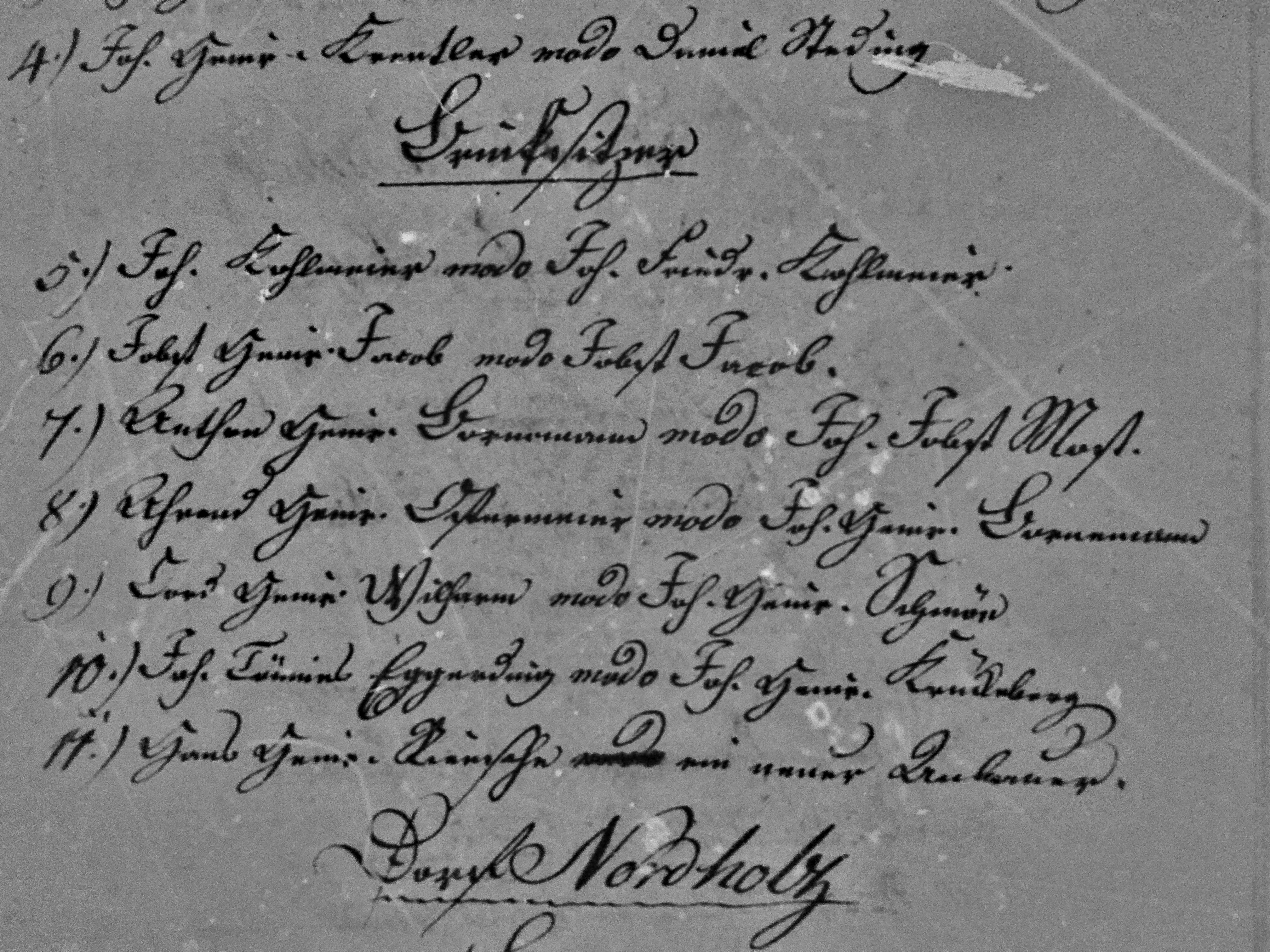
Transliteration and Translation
|
There is an important connection between Johann Tönnies Eggerding and Johann Heinrich Krückeberg. As shown below, not only was Johann Tönnies Eggerding the former resident at no. 10 Berenbusch, he was a baptismal sponsor of Johann Heinrich Krückeberg’s son, Johann Friedrich, who was born in 1728. See 1728 Johann Friedrich Krückeberg Baptized. |
Joh. Heinr. Kreutler modo Daniel Steding

     Brinksitzer

5.) Joh. Kohlmeier modo Joh. Friedr. Kohlmeier
6.) Jobst Heinr Jacob modo Jobst Jacob.
7.) Anthon Heinr. Bornemann modo Joh. Jobst Most.
8.) Ahrend Heinr. Ostermeier modo Joh. Heinr: Bornemann
9.) Cord Heinr. Wilharm modo Joh. Heinr. Schmön
10.) Joh. Tönnies Eggerding modo Joh. Heinr. Kruckeberg
11.) Hans Heinr. Riensche und ein neuer Anbauen

         Dorf Nodholz
modo is Latin for "presently,lately now". Thus, this shows the change of holder for a numbered holding: Former holder → now → current holder. So the entry:
Joh. Tönnies Eggerding modo Joh. Heinr. Kruckeberg
means:
Johann Tönnies Eggerding, now Johann Heinrich Krückeberg.
This documents that Krückeberg had taken over that Brinksitzer holding by the time of the register.
This means, Johann Heinrich Krückeberg was the successor on this property. This passage is a succession list for Brinksitzer holdings, showing who previously held each house and who holds it now.