Document 6: Report of the aforementioned administrative offices
Essential Explanations to Understanding Document 6
Michaelmas
Michaelmas is the Feast of St. Michael the Archangel, observed every year on 29 September. In the late 18th and early 19th centuries, it was a major religious feast day in Christian Europe observed annually in both Catholic and Protestant territories.
As it does in this document, Michaelmas also functioned as a standard legal and economic term date:
-
rents, dues, and services often began or fell due at Michaelmas
-
contracts, tenancies, and obligations were frequently dated to it
-
administrations used it as a fixed annual reference point
In this document the annual financial fees begin on Michaelmas.
Meyerbrief
An understanding of what a Meyerbrief (translated as Meyer letter) was is essential in order to understand how property ownership differed from today and the 18th and early-to-mid 19th century in Schaumburg-Lippe.
Annaul Fees and Obligations (a Hearth Hen really?)
The 10 groschen 2 denarii (Kottzmis) was a small annual cash payment associated with cottager (Kötter) or tenant (Einlieger) status. The form is non-standard and likely local, but its placement and amount indicate a minor monetary due owed by an Einlieger as part of holding the tenancy.
The 6 groschen Mahlschweingeld was an annual milling-related fee. Such charges were commonly paid either for the right to use a manorial or official mill or as a compulsory fee tied to grain processing, regardless of actual use.
The 1 groschen Michilisschaz was a small annual term-day payment, almost certainly connected to Michaelmas as a fiscal date. While the spelling is non-standard, the context makes clear that it was a modest cash due assessed once per year.
The five Eredtetage[n] represent five days of unpaid manual labor owed annually. These were work obligations—typically agricultural or maintenance labor—performed for the authority or community rather than paid employment.
In addition to these, the tenant owed one smoke-hen, meaning one hen per year tied to maintaining an inhabited household (a “smoke” signifying a working hearth). The listed hunting, watch, and land obligations refer to customary non-monetary duties: participation in local guard or night watch rotations, compliance with hunting regulations or service when required, and fulfillment of general obligations connected to occupying and using the land under princely authority. As odd as it may sound, a smoked hen was annaul obligation of a someone holding a Meyerbrief, a inheritable tenancy right to land.
What this Document Tells Us about Jobst Heinrich’s Status
Jobst Heinrich Krückeberg is an Einlieger when he petitions to purchase land tenancy-rights from the government. An Einlieger was a person without an independent household or holding, living “in” someone else’s house or property. That status carried specific, often small, dues—precisely the kind you see in the document below (Kottzmis).
When Jobst Heinrich paid the purchase money (Kaufgeld), he did not buy land outright. He acquired the right to establish a holding under a Meyerbrief. At that point:
-
he had legal permission to build,
-
but he did not yet possess a functioning household,
-
and therefore his social–fiscal status had not yet changed.
What changed his status
Only after he:
-
constructed a dwelling,
-
occupied it (produced “smoke” from his chimney), and
-
was recognized by the authorities as settled on the site
would he cease to be treated as an Einlieger.
At that point, he would be regarded as a Kötter / Colon (or equivalent local category), and certain Einlieger-specific dues would typically fall away or be replaced by the standard obligations of a settled holding.
This is exactly why the document specifies that the obligations begin at Michali 1813: it presupposes a transition period between approval, construction, and full fiscal incorporation of the new holding.
Why Kottzmis still appears here
The presence of Kottzmis (an annual money due) reflects current or transitional status, not a permanent one:
-
it signals how he is classified at the time of assessment,
-
not necessarily how he will be classified forever.
Early modern administrations were status-sensitive, not abstractly contractual. Obligations followed who you were and how you lived, not just what you had permission to do.
Bottom line
-
✔ Kottzmis is a cottager-level monetary due, and in this document it reflects Jobst Heinrich’s current Einlieger classification, not his eventual status.
-
✔ Purchasing tenancy rights alone does not end that status.
-
✔ Status changes only after building, moving in, and recognition
-
✔ The document reflects a process, not an instantaneous transformation in status,
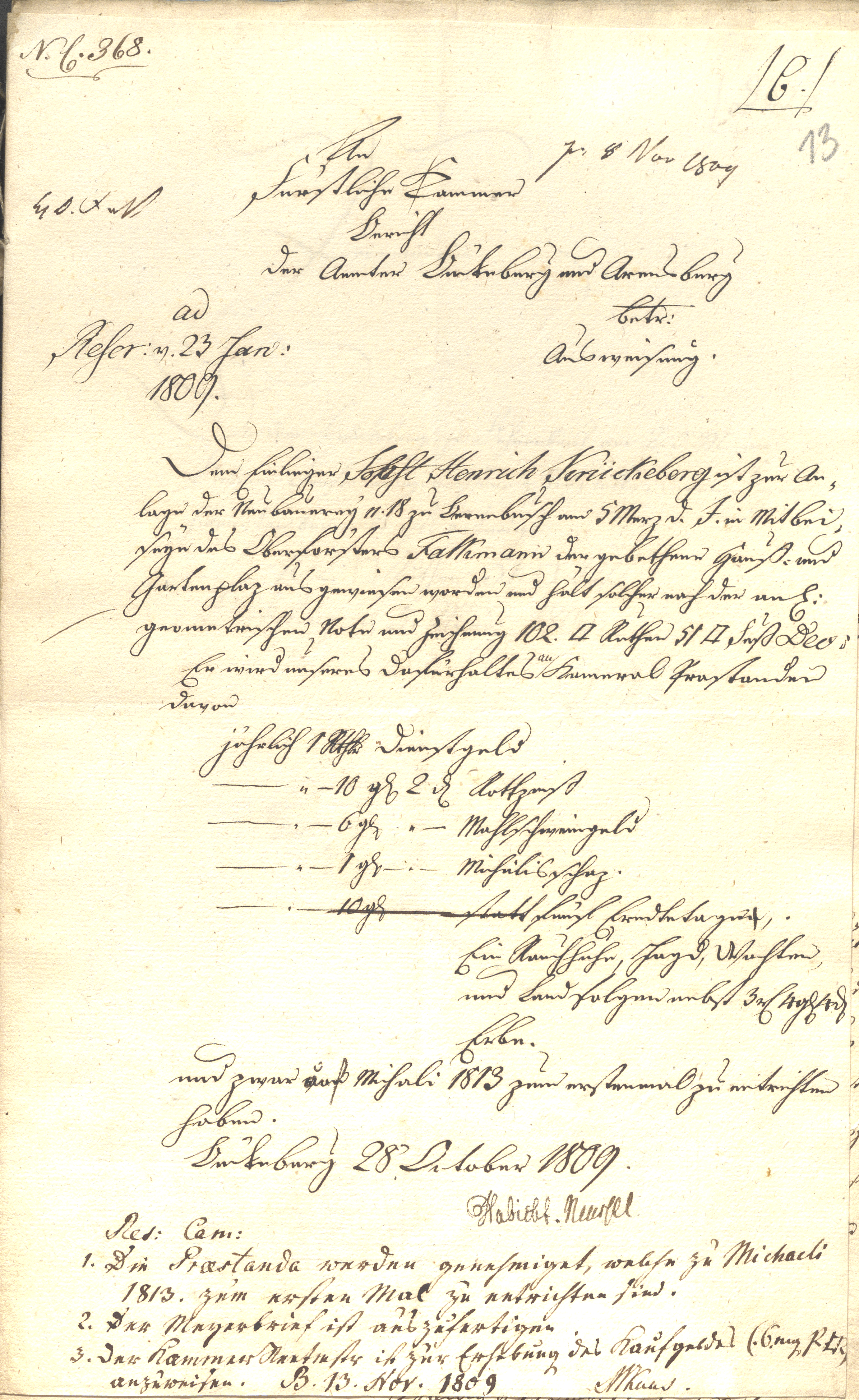
Transliteration and Translation
N. C. 368.
pr. 8 Nov 1809

[Four-letter marginal filing and routing marks
without semantic relevance to the case content]

An Fürstliche Kammer Bericht
der Aemter Bückeburg und Arensburg
betr: Ausweisung.

ad Rescr: v. 23 Jan: 1809.

Dem Einlieger Jobst Henrich Krückeberg ist zur Anlage der Neubauereÿ
n.18 zu Berenbusch am 5 März d. J. in Mitbeiseÿn des Oberforsters
Falkmann der gebethene Haus- und Gartenplaz ausgewiesen worden, und
hält solcher nach der an:

geometrischen Note und Zeichnung 102. [Quadrat] Ruthen 51 [Quadrat] Fuß Dec.

Er wird unseres Dafürhaltens in kammeral Prästanden davon

jährlich 1 Rthlr Dienstgeld
[jährlich] 10 g. 2 d. Kottzmis
[jährlich] 6 gl. Mahlschweingeld
[jährlich] 1 gl. Michilisschaz
[jährlich] fünf Eredtetage[n],
ein Rauchhuhn, Jagd-, Wacht-
und Landfolgen nebst 3 rt. 4 g. 4 d. Erbe,

und zwar auf Michali 1813 zum erstenmal zu entrichten haben.

Bückeburg 28 October 1809.
Habicht-Neuesl

Res: Cam:
1. Die Prästanden werden genehmiget, welche zu Michali 1813 zum
ersten Mal zu entrichten sind.
2. Der Meyerbrief ist auszufertigen
3. Der Kammerrenttmeistr ist zur Erhebung des Kaufgeldes (6. Mg. p. M.)

B. 13 Nov. 1809
MKaas
|
In the manuscript, jährlich ("annually") appears only with the first charge: "jährlich 1 Rthlr Dienstgeld". The horizontal repetition strokes that appear in the image indicate that jährlich applies equally to each of the following charges; all listed payments and obligations are due annually. Also note that several terms in the list of charges appear in non-standard or locally specific spellings. Such variation is common in administrative records of this period and does not necessarily indicate error; some forms may reflect local usage or abbreviated scribal practice. |
N. C. 368.
submitted 8 Nov. 1809

[marginal note]
(undeciphered docket mark)

To the Princely Chamber
Report of the Offices of Bückeburg and Arensburg
Re: allocation.

with reference to the rescript of 23 Jan. 1809.

For the establishment of the new site no. 18 at Berenbusch, the tenant
Jobst Henrich Krückeberg was, on 5 March of the current year and in
the presence of the chief forester Falkmann, assigned the requested
house and garden plot, which, according to the enclosed geometric note
and drawing, comprises 102 square rods and 51 square feet decimal.

In our judgment, he will therefore have, in chamber dues, thereof
annually

1 Reichsthaler in service money
— 10 groschen 2 denarii as a cottager’s cash due (Kottzmis)
— 6 groschen as milling fee money (Mahlschweingeld)
— 1 groschen as a Michaelmas-related due (Michilisschaz)
— five days of manual labor (Eredtetage[n])
one smoke-hen, hunting, watch, and land obligations, together
with 3 Reichsthaler 4 groschen 4 denarii hereditary fee,
and that beginning at Michali 1813 (29 Sept. 1813) for the first time.

Bückeburg, 28 October 1809.
Habicht-Neusel

Chamber resolution:

The dues are approved and begin at Michaelmas 1813 (29 Sept. 1813) for the
first time.

The Meyer letter is to be issued.

The chamber treasurer (Kammerrentmeister) is instructed to collect the purchase money
(6 Mariengroschen per Morgen).

B[ückeburg]., 13 Nov. 1809
MKaas